
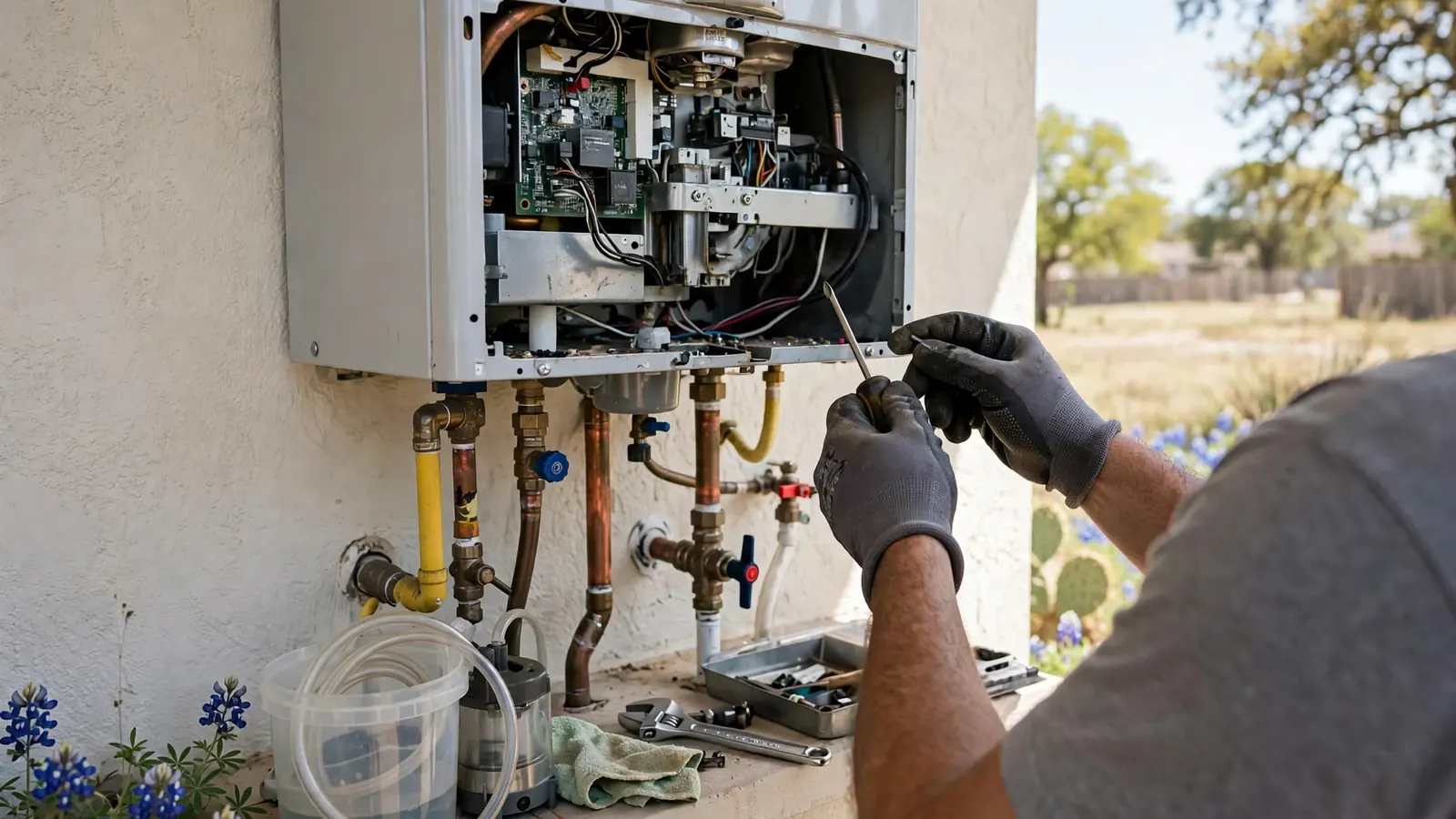
Tankless Water Heater Sizing in Randolph, MA: A Simple Guide
Sizing a tankless water heater is different from sizing a tank. You do not pick gallons. You pick how many gallons per minute the unit can heat, and by how many degrees.
This guide explains the math in plain steps, using Randolph's incoming water temperature, and points out the gas and venting questions that change the answer.
The two numbers that size a tankless heater
Every tankless heater is rated by flow rate in gallons per minute and by the temperature rise it can deliver at that flow. The rise is the difference between the cold water coming in and the hot water you want out.
In a Massachusetts winter, the water at the street can fall into the low 40s Fahrenheit. If you want 120 degree water at the tap, the rise is about 75 to 80 degrees. A unit that delivers 5 gallons per minute at a 50 degree rise may deliver only 3 or less at a 77 degree rise. That is why a unit sized for a warm climate can fall short here in January.
The right size comes from two numbers: how many fixtures run at once, and the winter rise. Together they give the peak flow the unit must deliver.
Typical flow rates by fixture
| Fixture | Approximate flow (gallons per minute) |
|---|---|
| Showerhead. | About 1.5 to 2.5 |
| Bathroom sink. | About 0.5 to 1.5 |
| Kitchen sink. | About 1.5 to 2.5 |
| Dishwasher. | About 1.0 to 2.0 |
| Washing machine. | About 1.5 to 3.0 |
| Bathtub filler. | About 4.0 to 6.0 |
Add the flows for the fixtures that could run together at your busiest time. Two showers and a dishwasher might total 6 gallons per minute, and that is the number the winter rise has to meet.
A five-step sizing worksheet
List your peak fixtures
Which fixtures run together on a busy morning?
Add the flow rates
Use the table above to total the gallons per minute.
Find the winter rise
Subtract the cold inlet temperature from the temperature you want.
Check the manufacturer's chart
Match the unit that delivers your flow at that rise.
Check gas and venting
Confirm the gas line and vent path can support the unit.
Want a sizing check?
Call and a plumber will run the numbers.
Gas line and venting are part of the size
A tankless gas heater needs much more gas for a few seconds than a tank needs over an hour. Many houses have a half-inch gas line that serves a furnace and a range, and a large tankless unit may require three-quarter inch piping. Undersized gas lines cause low-fire faults and cold water.
Venting matters too. Condensing units use plastic pipe and run cooler. Non-condensing units need stainless steel venting. Massachusetts requires licensed gas fitting and permits, and Randolph's plumbing inspector reviews the work on Mondays, Wednesdays and Thursdays.
Gas or electric tankless
Gas tankless
- Delivers higher flow rates for larger houses.
- Needs a gas line sized for the load and a vent.
- Condensing models run efficiently.
- Ideal where gas is already present.
Electric tankless
- No vent or gas needed.
- Needs a very large electrical circuit.
- Often limited in flow in cold climates.
- Best for small loads or point-of-use.
Our tankless water heater service page covers installation and flushing, and water heater installation compares tank and tankless options.
Randolph's incoming water temperature and soft water
The town's 2024 report lists hardness of 39.6 ppm, which is soft, so scale on a heat exchanger builds slowly. Randolph's supply comes from surface reservoirs, which run cold in winter. We size on the winter figure, not the summer one, so the unit performs in January.
If your house has several bathrooms and a long run from the heater, a small recirculation loop or a second unit can solve the wait for hot water.
Source type: Town of Randolph 2024 Drinking Water ReportWhat this means for your house
A two-person household with one bathroom needs a very different unit from a family of five with three bathrooms. Walk through the worksheet above, or call and a plumber will do it with you. We check the existing gas line and vent as part of every estimate, and we tell you honestly if a tank is the better choice.
If you live in Canton or Braintree, we do the same estimates there. See Canton or Braintree for dispatch details.
Common sizing mistakes
The first mistake is sizing for the average day instead of the busiest one. A unit that handles a single shower does not handle two showers and a dishwasher together. The second is using summer water temperature in the math. A heater that performs well in August can run short in January when the incoming water is much colder.
The third is ignoring the gas line and vent. A larger unit with a bigger burner may need a three-quarter inch gas line, a longer vent run or a different vent material. These items change the installed price more than the size of the unit does, and they should be in the quote from the start.
A fourth is forgetting hot water wait time. A tankless heater makes hot water on demand, but it cannot shorten the pipe between the heater and a distant bathroom. A recirculation loop or a small point-of-use tank can help a long run feel faster.
What we check in a Randolph house
A sizing visit starts in the utility room. We look at the gas line diameter, the meter, the vent path and the electrical outlet. Then we count the fixtures and ask when they are used. With those numbers we match the winter rise to a model and tell you whether it fits.
If the numbers do not work, we say so. A high-efficiency tank is sometimes the better match for a small household with a tight utility space, and we would rather recommend that than sell a unit that disappoints.
Safety steps before any installation
A gas tankless unit needs proper venting and a correct gas line. Do not attempt either yourself. Keep a working carbon monoxide detector near the heater and outside sleeping areas, and shut off the gas and call a plumber if you smell gas.
Installations follow 248 CMR 10.00, the Uniform State Plumbing Code, and the work needs a permit and inspection.
Tankless sizing questions from Randolph homeowners
It depends on peak flow and winter rise. Many families of four land in the 7 to 9 gallons per minute range at a high rise for a gas unit, and a plumber confirms with your fixtures.
Not when sized correctly, but it can fall short if more fixtures run than it was sized for.
Often yes. Many houses need a larger gas line for a large tankless unit.
It can fall into the low 40s Fahrenheit, which is why winter rise matters.
For a small household a smaller unit or a high-efficiency tank may be a better value. We tell you plainly.
Still unsure which fix fits? A dispatcher can talk it through on the 24/7 line at (508) 389-4045.