
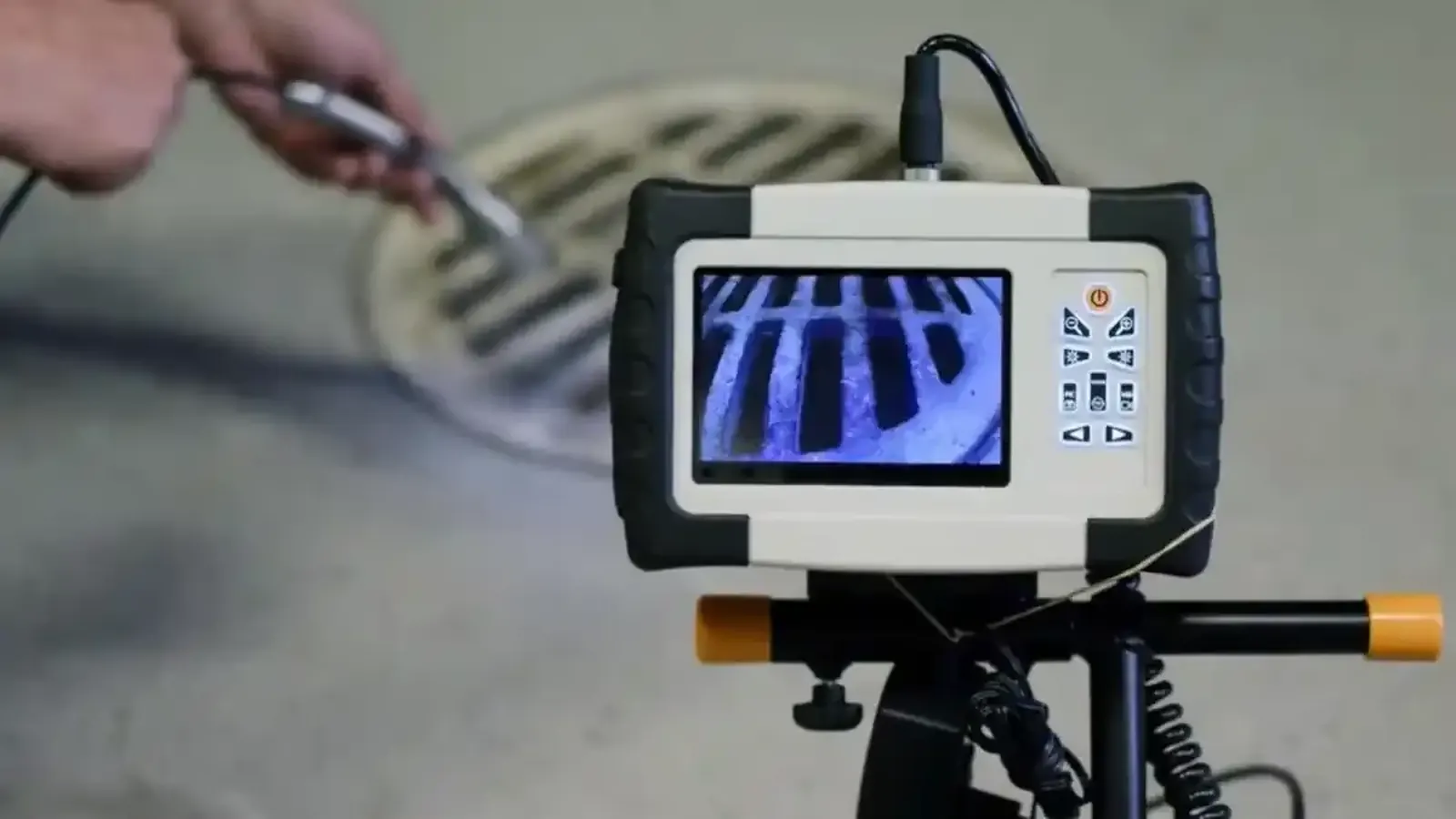
Sewer Camera Inspection Results Explained | Randolph, MA
A sewer camera inspection gives you a video of the inside of your drain. The picture is only useful if you can tell a normal joint from a crack and a shadow from a sag. This guide explains how to read the video and what each finding means for your house.
If you want to know whether you need an inspection at all, see our page on the service. This article is about the results.
What a clean line looks like
On the screen, a healthy pipe looks like a round, evenly lit tunnel. The joints between pieces of pipe appear as thin lines at regular intervals, spaced by the length of a pipe section. The wall is smooth, without cracks, roots or buildup. Water at the bottom of the pipe is normal, a thin trickle during a flush.
Camera heads have lights and a self-leveling lens, so the picture stays upright as the head moves. A transmitter in the camera lets the plumber find its position above ground, so each finding comes with a depth and a location.
Footage counters
Many systems show the distance traveled in feet from the cleanout. A finding is recorded at a distance, such as 38 feet from the cleanout.
Pipe material
Clay shows short sections with visible joints. Cast iron has a rough, scaly wall. PVC is smooth and white or gray.
How to read common findings
| What you see | What it means | Typical next step |
|---|---|---|
| Fine white roots along a joint. | Roots entering a joint. | Jetting, then watch the line. |
| A mass of roots filling the pipe. | Heavy root intrusion. | Cut roots, then repair the joint. |
| A crack along the pipe. | Structural damage. | Spot repair or lining. |
| A step or offset at a joint. | Shifted pipe that snags paper. | Repair if it causes repeat clogs. |
| Standing water for a long stretch. | A belly or sag in the pipe. | Monitor, or replace the section. |
| Rough scale on cast iron. | Corrosion and buildup. | Jetting, and monitor wall thickness. |
| Pipe collapsed or crushed. | Total failure. | Replace the section. |
| Grease along the wall. | Fat buildup. | Jetting and habit change. |
Which findings need action and which can wait
Not every finding needs a repair. A few fine roots at a joint can be managed with cleaning. A small offset that does not snag anything may be left alone. Collapsed pipe, a mass of roots, an active leak or a belly that holds sewage need attention.
A good plumber tells you which category each finding falls in and what could change. Our sewer camera inspection service gives you the video and a written summary, and the sewer line repair page covers the repair options.
Backup happening now?
Stop using water and call the 24/7 line.
What to do with the video
Save a copy
Keep the video. Agents, buyers and insurers may ask for it.
Ask for the distance and depth of each defect
This tells you where and how deep any digging would be.
Ask what is urgent
A good plumber separates must-fix from can-watch.
Get options in writing
Spot repair, lining and replacement have different costs and lifespans.
Do not delay a collapse
A collapsed line will back up and cannot be cleared.
Randolph lines and what a camera often finds
The state survey of Randolph's housing describes a population that rose from 9,982 in 1950 to 29,206 in 1975, with most of that growth in suburban houses. The sewer laterals serving those houses are now 50 to 75 years old, and many are clay or cast iron.
The Cochato River and several brooks cross the town, and mature trees grow near them. Roots seek the moisture at pipe joints. When the camera shows a root mass, the question is not whether to cut it but whether the joint needs repair. The town's DPW Sewer line, 781-961-0941, can discuss the public main. Your private line is your responsibility.
Source type: Massachusetts Historical Commission survey of Randolph and Town of Randolph DPWFindings that point to cleaning or repair
Cleaning is usually enough when
- The pipe is round and intact.
- Roots are fine and limited.
- Grease or scale is the only problem.
- There are no cracks or offsets.
Repair is usually needed when
- The pipe is cracked, broken or collapsed.
- Roots have opened a joint.
- A belly holds waste.
- A joint is displaced.
Next steps
If your camera video shows heavy buildup, hydro jetting is the usual first step. If it shows a break, a repair is next. We serve Holbrook and Braintree as well, as described on the Holbrook and Braintree pages. For a sewage backup right now, call the 24/7 line.
Questions to ask about your video
When you review a camera video with a plumber, ask a few direct questions. How far from the cleanout is each defect? How deep is it? What is the pipe made of? Is the finding stable or likely to worsen? What are the options, and what does each involve?
Ask also whether the camera was able to travel the whole line. A video that ends at a blockage or a break does not show what lies beyond. If the line could not be completed, the plumber should say so, and explain what might be hidden.
If you are buying a house, share the video with your attorney and agent. A repair credit or a seller repair can be negotiated, but only if the findings are in writing.
What the camera cannot tell you
A camera shows the inside of the pipe, not the soil around it. It cannot say how much weight a cracked section can carry, or whether tree roots are pressing on a joint from outside. It also cannot see past a full blockage, which is why a line is usually cleaned before it is scanned.
That is why we pair the video with a plain explanation. We tell you what we saw, what we could not see and what we would do next. A scan is information to act on, not a verdict, and we would rather recommend a small repair now than a large one after a backup.
Camera inspection questions from Randolph homeowners
The camera system records the distance in feet from the entry point, and the plumber can mark the surface.
Not always. A hairline crack that is not leaking may be monitored. A wide crack or one with roots needs repair.
Yes, unless the joint is repaired or the roots are managed.
A camera can inspect the line to a tank. The tank itself is a different service.
A video is a snapshot. A line can change over time, so buyers often want a recent one.
Still unsure which fix fits? A dispatcher can talk it through on the 24/7 line at (508) 389-4045.