
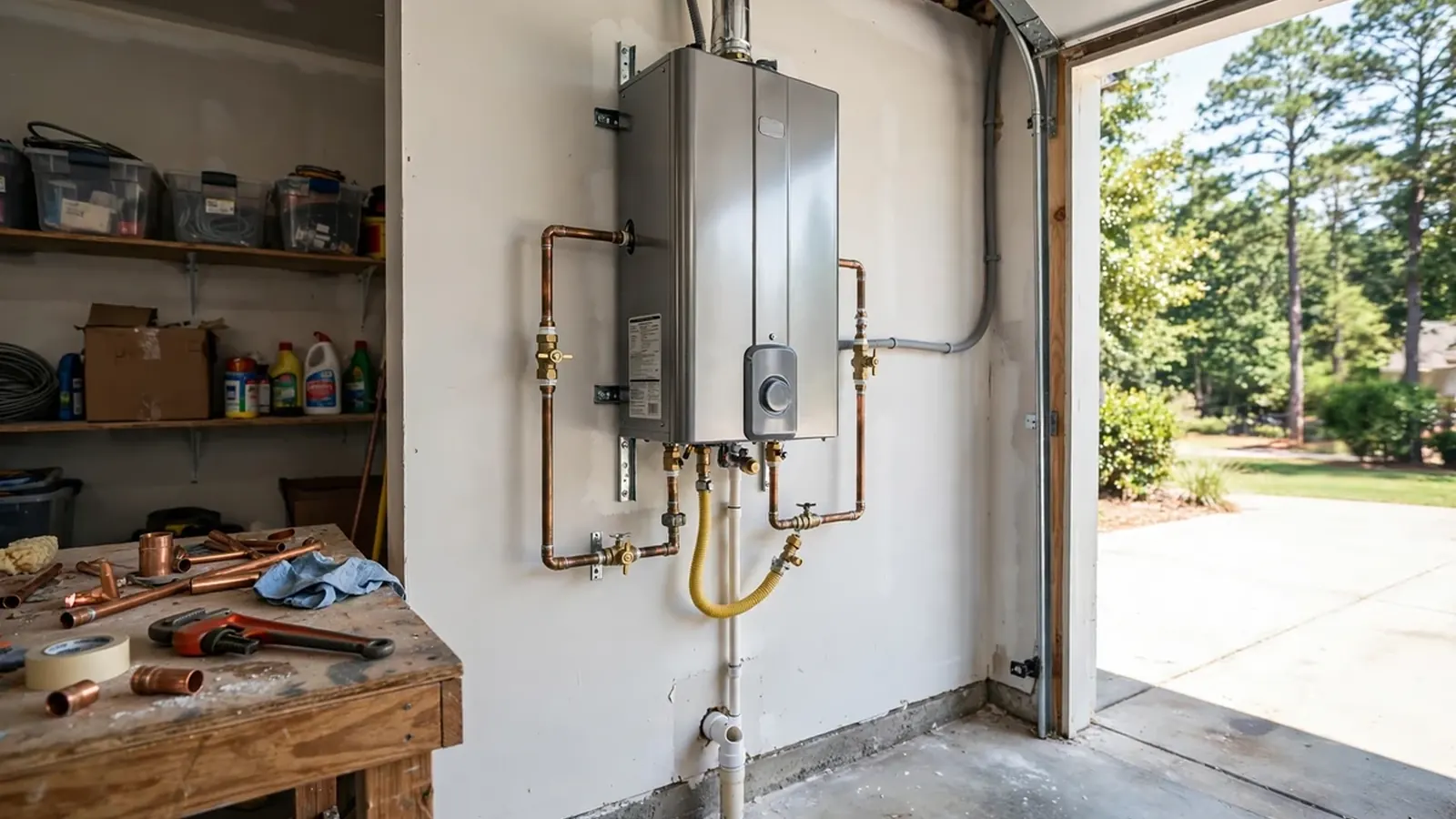
Condensing Tankless Water Heater in Randolph, MA: Is It Right
A condensing tankless water heater squeezes extra heat out of its exhaust, which makes it more efficient than a standard tankless unit. It also makes acidic water that has to go somewhere, and it uses plastic vent pipe that behaves differently from metal.
Before you choose one for a New England house, it helps to know what it needs and where it can go wrong.
How a condensing unit works
A standard gas tankless heater has one heat exchanger. Hot exhaust gases leave through a metal vent at a high temperature, carrying wasted heat with them. A condensing unit adds a second heat exchanger that captures heat from the exhaust before it leaves.
By the time the exhaust reaches the vent it is cool enough that water vapor in it condenses into liquid. That liquid is the condensate. It is mildly acidic, with a pH often between 3 and 5, and it has to drain from the unit through a trap or a neutralizer into a proper drain.
The cooler exhaust is also why condensing units can be vented with PVC, CPVC or polypropylene pipe instead of stainless steel, which makes venting easier and often cheaper in a retrofit.
Condensing versus non-condensing tankless
| Feature | Condensing | Non-condensing |
|---|---|---|
| Efficiency. | Higher. | Lower. |
| Vent pipe. | PVC, CPVC or polypropylene. | Stainless steel. |
| Condensate drain. | Required. | Not required. |
| Cost of the unit. | Higher. | Lower. |
| Freeze risk in the vent and drain. | Yes, in cold spaces. | Lower. |
Our tankless water heater service page covers installation, flushing and repair for both types.
What a condensing unit needs from the house
- A condensate drain. A floor drain, a laundry standpipe or a condensate pump that carries the liquid away.
- A neutralizer. A small cartridge of limestone or similar media raises the condensate pH before it enters your drain.
- A vent path. Plastic pipe runs to the outside through a wall or the roof, with the right slope.
- A gas line sized for the load. Many units need more gas for a short time than a tank.
- Power. The fan, the control board and the igniter need a nearby outlet.
Thinking about a condensing unit?
Call and a plumber will look at the space and the gas line.
Winter in Randolph and the condensate line
A New England basement corner can sit near freezing during a cold snap, and the condensate trap and drain line are small enough to freeze solid. When that happens the unit shuts down with a fault code, and the cause is easy to miss because the water in the pipes is fine.
We keep the drain route short and inside the heated part of the house, and insulate the line where it crosses a cold space. The vent termination outside also needs a clear path. Snow drifts against an exterior wall can block the intake or exhaust, and a unit that stops during a storm often needs only a clear vent.
Yearly care for a condensing unit
Clean the inlet screen
Grit in the cold water inlet cuts flow and trips a low-flow fault.
Flush the heat exchanger
A descaler solution clears mineral buildup. Randolph's soft water means this builds slowly, but it still happens.
Check the neutralizer
The media wears out and should be replaced on the maker's schedule.
Clear the vent
Look outside for debris or snow near the termination.
Test the unit
Run hot water and watch the temperature and any fault codes.
Randolph rules for gas appliances
A gas tankless install needs a permit and an inspection. Randolph's plumbing inspector is in on Monday, Wednesday and Thursday, and permits are issued through the building department at 41 South Main Street. Only licensed plumbers can pull the permit, and gas work needs a licensed plumber or gas fitter.
The town's drinking water is soft, at 39.6 ppm in the 2024 report, which is gentle on the heat exchanger. That does not remove the need for a periodic flush.
Source type: Town of Randolph Building Department and 2024 Drinking Water ReportIs a condensing tankless right for your house?
A condensing unit suits a house with a nearby drain, a heated utility space and a gas line that can be upsized. It is a good match for a family that uses hot water in long stretches. If the heater sits in an unheated garage or a cold crawlspace, a tank or a different location may be a better fit.
Our water heater installation page compares the options, and we are happy to look at your space before you decide. We serve Canton and Braintree as well, as described on the Canton and Braintree pages.
What the cost difference really buys
A condensing unit costs more than a standard tankless heater, and the difference is the second heat exchanger and the more complex controls. What you get in return is lower fuel use for each gallon of hot water, and more flexible venting, since plastic pipe is easier to route than stainless steel.
Whether the savings pay back the extra cost depends on how much hot water you use. A busy household that runs hot water daily will see the gap close faster than a small one. A plumber can estimate it from your fuel use and the unit's efficiency rating.
The savings are also not free of upkeep. The neutralizer media, the condensate trap and the drain line need attention, and a unit that is ignored can lose its efficiency. We treat the yearly service as part of owning one.
Choosing the location
The best location is on an outside wall in a heated space, close to a drain and to the gas meter. A basement utility room near the foundation wall often fits. A closet in the middle of the house is harder, because the vent has to travel farther.
Avoid unheated garages and crawlspaces. A condensate line in an unheated space is one cold snap from a freeze-up, and a service visit to thaw it is an avoidable call.
Condensing tankless questions from Randolph homeowners
It is mildly acidic water from the exhaust. A neutralizer raises the pH so it can go to a drain.
The condensate trap, the drain line and the vent can freeze in a cold space. Placement and insulation prevent it.
They are more efficient than non-condensing units, so they use less fuel for the same hot water.
PVC, CPVC or polypropylene, depending on the manufacturer.
Gas work in Massachusetts requires a licensed plumber or gas fitter, and a permit.
Still unsure which fix fits? A dispatcher can talk it through on the 24/7 line at (508) 389-4045.